
At iCapital, every investment decision starts with one question: what will allow this business to keep earning high returns for years to come? Our philosophy is to look for Vietnamese businesses with reasonable valuations, durable competitive advantages and excellent management. That is why the team chose Pat Dorsey’s The Little Book That Builds Wealth for an internal book-sharing session.
Pat Dorsey was formerly Director of Equity Research at Morningstar. His book answers that question with one simple idea: the economic moat – a durable competitive advantage that keeps rivals at bay, like the moat around a castle.
1. Why competitive advantage matters most
The session opened with a simple example. There are three towns, A, B and C; A and C have barbershops, B does not. Mr. X opens a shop in B and earns large profits, because residents no longer have to travel.
But large profits attract competitors. New shops open, the gap closes, and Mr. X’s return on capital falls back to normal. He made money by finding a new market – not by owning a competitive advantage.
Our yardstick is ROIC – return on invested capital: how much profit a business generates for every 100 dong of capital put to work.
ROIC = EBIT × (1 − t) ÷ Invested capital
= (EBIT ÷ Sales) × (Sales ÷ Invested capital) × (1 − t)
Here, EBIT is earnings before interest and tax, t is the tax rate, and invested capital equals net working capital plus net fixed assets. The formula splits ROIC into two parts: operating margin (pricing power with customers) and capital turnover (efficiency in production and selling). A real moat lifts at least one of the two – and sustains it over a long period.
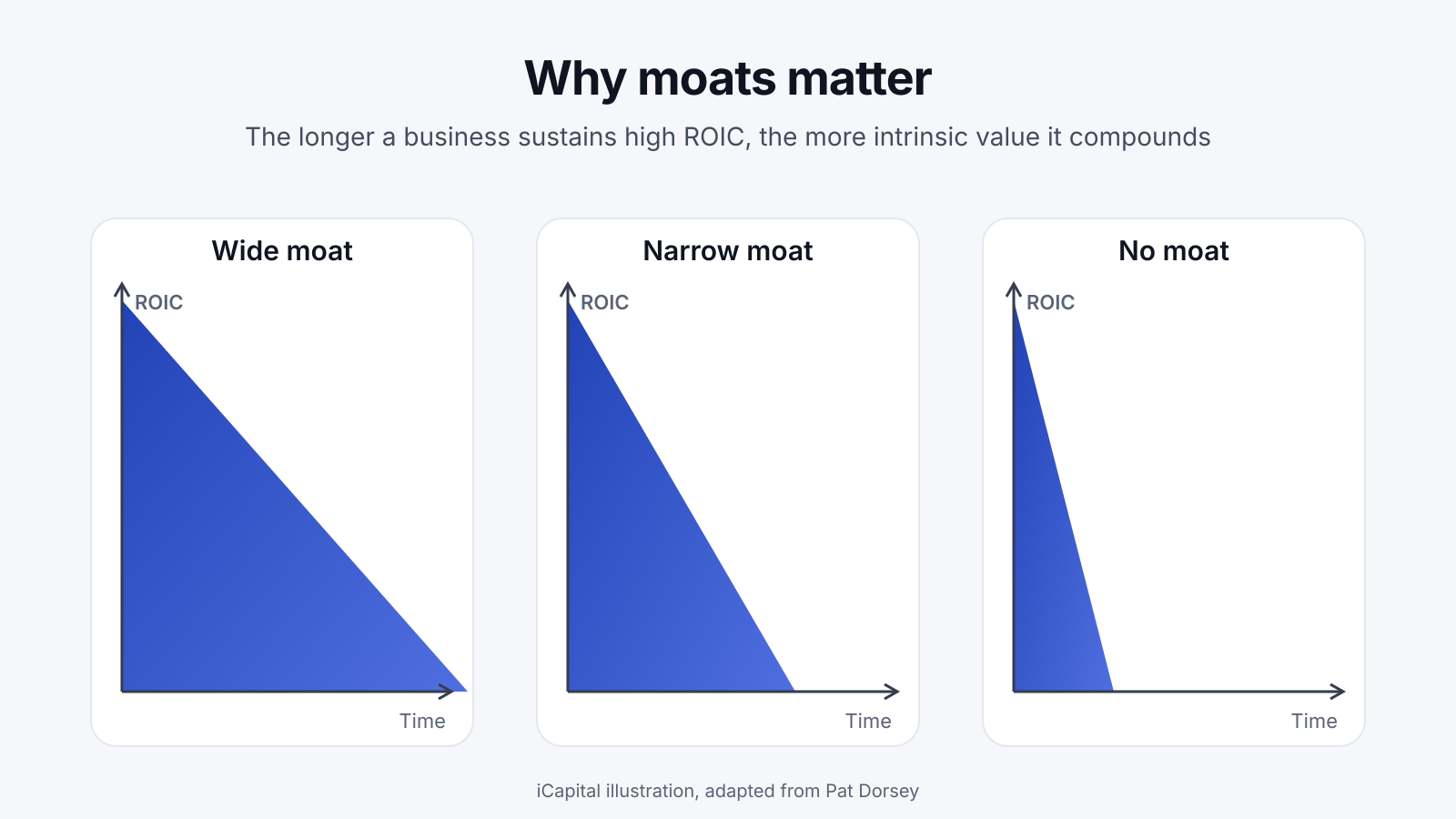
Businesses with wide moats sustain high ROIC for longer and therefore compound more intrinsic value (illustration adapted from Pat Dorsey’s Talks at Google presentation).
2. Pat Dorsey’s four-step process
- Identify companies that can earn above-average ROIC for many years.
- Value them, and wait patiently for a reasonable price.
- Hold until the moat erodes, the price runs too high, the original thesis proves wrong, or a better opportunity appears.
- Repeat.
Step 1 is where fundamental analysis makes the difference. A moat reduces the risk of misjudging a company’s prospects and limits the damage if you overpay.
3. “Mistaken moats”
Dorsey argues that a moat comes from the structure of the business, not from any one individual. Four things sound attractive but are not necessarily moats:
- A great product: competitors can still copy it.
- High market share: ask how it was won, and whether it can be kept.
- Great execution: only a moat if the process is genuinely hard to imitate.
- Great management: managers can leave; past success does not guarantee future results; and judging management is easy in hindsight but very hard in advance.
4. The four real sources of moats
| Moat type | What it is | Questions to test it | Examples discussed |
|---|---|---|---|
| Intangible assets (brands, patents, licences) | Customers pay more, or regulation keeps new entrants out | Can the company charge more for the same product? Does the licence come with a price cap? | Tiffany, PNJ (jewelry); IDP with the IELTS test |
| Switching costs | Customers avoid switching because of cost, retraining or risk | What keeps customers from leaving? What does the company do to raise that barrier? | Accounting software, databases, Adobe; aircraft components |
| Network effects | The product becomes more valuable as more people use it | Does each new user improve the service? Could a later entrant overtake the network? | MoMo, Microsoft Office, Facebook, the stock exchange |
| Cost advantages (process, location, unique assets, scale) | Sell at the same or a lower price and still earn a profit | What would it cost a rival to match? Is the industry heavy in fixed costs? | Cement plants near end markets; low-cost ore mines; Thiên Long and Hồng Hà in niche markets |
One point from the discussion: a famous brand is not automatically a moat. Sony is well known, yet customers still compare prices; a luxury jeweler, by contrast, can charge more for the same amount of gold.
5. When moats erode
Even strong moats can be breached. Dorsey highlights three main causes:
- Technological change: Nokia before the smartphone wave, Kodak when digital photography arrived.
- Industry shifts: large retailers squeezing brands on price; competitors that do not put profit first, such as some state-owned firms, entering the market.
- The wrong kind of growth: expanding into businesses where the company has no competitive advantage.
The clearest warning sign is when customers start saying: “I won’t pay more – there is better value elsewhere.”
6. From the book to iCapital’s research process
The session did not stop at theory. The moat framework feeds directly into how the team works:
- Competitive advantage is a core part of every company analysis, tested with the questions above and checked against ROIC over many years.
- Advantages must be quantified. In our DDV report (December 2024), for example, the team placed DDV on the global DAP fertilizer cost curve. Domestic ore priced 30–40% below market lets DDV compete with Chinese producers that do not own mines – a “unique asset” moat.
- A moat must come with the right price. A good business bought at too high a price can still be a poor investment, so valuation and margin of safety always go together.
See how this works in practice in three investment cases: VIP, DDV and VRE.
Further reading
- Video: The Little Book That Builds Wealth | Pat Dorsey | Talks at Google (YouTube)
Conclusion
For iCapital, competitive advantage is not a box to tick in a report. It is the reason a business can compound value over many years. We will continue to hold book-sharing sessions like this one to strengthen the team’s long-term value-investing mindset.
Sources:
- Pat Dorsey, The Little Book That Builds Wealth (Wiley, 2008)
- The Little Book That Builds Wealth | Pat Dorsey | Talks at Google (YouTube) – source of the idea behind the “Why Moats Matter” chart
- Investment philosophy: iCapital – Investment Solutions
- iCapital, DDV equity research report, 13 December 2024 (internal)