
On 25–26 June 2026, iCapital staff attended the short course “The DPPA Mechanism and the Electricity Market in Vietnam”, organised by EAVCED with leading industry experts. Below is a summary of part of Module 5, “Guide to registering for DPPA”, distilled by the iCapital team from the perspective of an investor that owns a renewable energy project and wishes to participate in the DPPA mechanism.
For renewable energy developers, the direct power purchase agreement (DPPA) mechanism via the national grid opens up an additional way to find customers and agree long-term commercial terms. This handbook follows the seller's preparation steps, from project review, customer selection and contract negotiation to completing technical infrastructure, registration and post-operation cash flow management.
Regulations are referenced against Decree 57/2025/ND-CP, as amended by Decree 243/2026/ND-CP, and related sector regulations. In this article, “amended Decree 57” refers to the decree as updated; Consolidated Document 53/VBHN-BCT is used for ease of reference.
1. Understanding the transaction relationships and payment flows
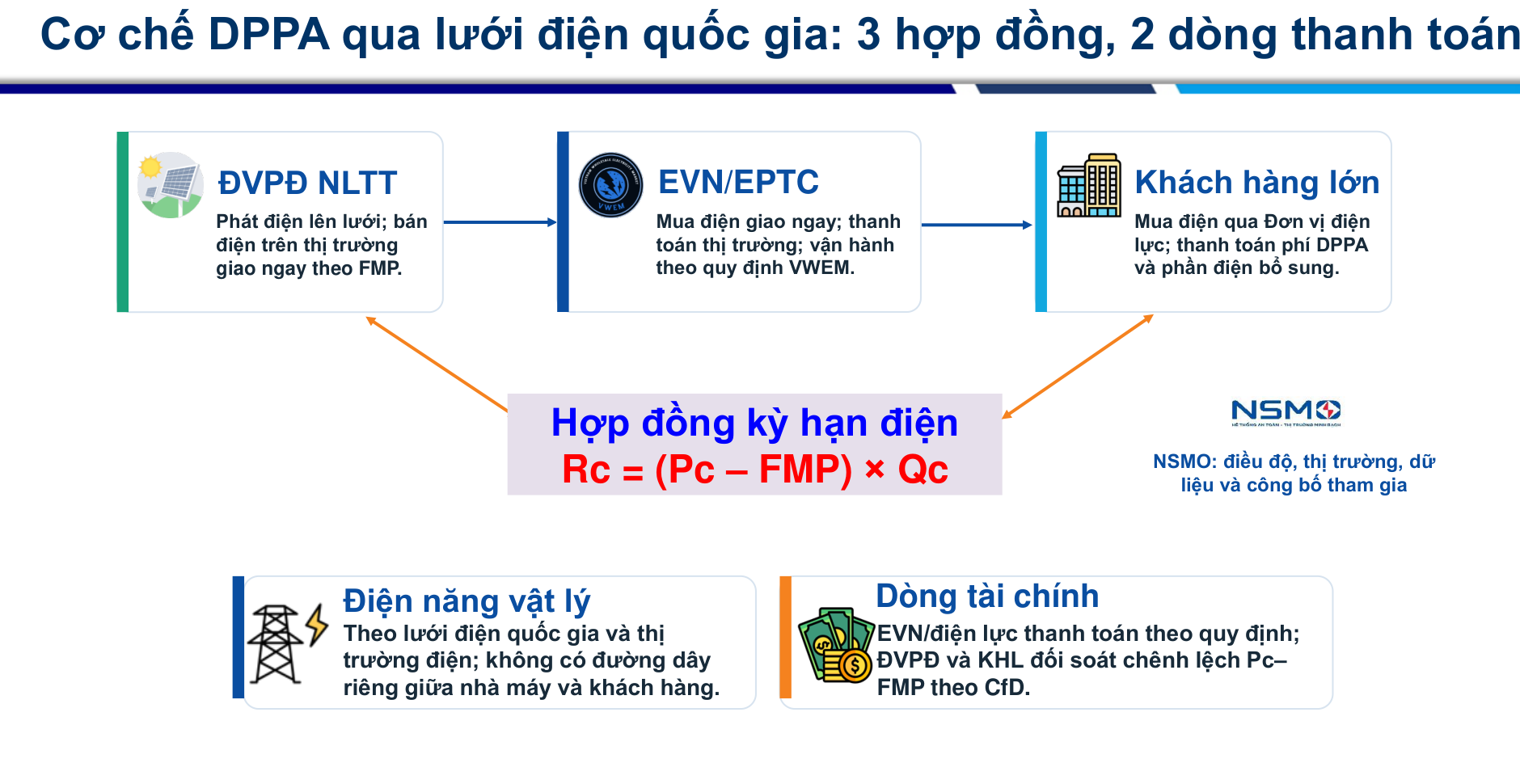 Figure 1. The transaction mechanism via the national grid (diagram in Vietnamese).
A DPPA via the national grid is carried out through three contractual relationships:
- Generator – EVN or its authorised entity: the plant sells all of its output on the spot electricity market under a spot market power purchase agreement.
- Customer – Power Corporation/Power Company: the customer continues to buy and receive electricity through the national power system and pays under a power purchase agreement that applies the DPPA mechanism.
- Generator – customer: the two parties sign a forward electricity contract that sets the strike price, the contracted volume and the obligation to settle the difference.
Physical electricity is delivered through the national power system. The direct commercial relationship between the plant and the customer is expressed through the forward contract, commonly known in practice as a contract for difference (CfD).
NSMO – the National Power System and Market Operator Company Limited handles dispatch, market operation, registration management and the announcement of the official participation date. Developers should distinguish this role from that of EVN or its authorised entity, which buys electricity and pays under the contract.
Legal basis: Article 4(2); Articles 9, 15, 17 and 20 of amended Decree 57.
2. Reviewing the conditions of the power plant (seller) and selecting customers (buyer)
2.1. For the power plant (seller)
Developers should draw up a checklist of conditions to ensure the project can participate in DPPA:
- Eligibility: renewable energy generators using wind, solar or biomass, with capacity of 10 MW or more, connected to the national power system and participating directly in the competitive wholesale electricity market.
- Project legal status: review planning, investment approval, land, environment, construction, fire safety and other relevant approvals.
- Grid connection and operation: check the connection agreement, test results, acceptance, electricity operation licence and commercial operation status.
- Electricity market readiness: assess the ability to submit offers, receive dispatch instructions, transmit operating data, and handle metering, reconciliation and payment.
- Existing contracts: if the plant already has a power purchase agreement, its termination must be handled to switch to DPPA in line with regulations and the relevant agreements; review obligations already incurred and lenders' conditions.
Each condition should have an owner, a deadline and supporting documents. This approach helps developers see which tasks can be prepared in advance and which must be completed before official operation.
2.2. For large electricity customers (buyer)
Developers should check both the customer's eligibility and its commercial fit:
- Large electricity customers must meet the eligibility and usage-purpose criteria under amended Decree 57, with a connection voltage of 22 kV or higher.
- The average monthly consumption threshold for DPPA via the national grid is 200,000 kWh or more:
- For customers that have used electricity for 12 months or longer, compare against the monthly average of the most recent 12 months; for less than 12 months, compare against the expected volume as regulated.
- This condition is also reviewed for continued participation in subsequent years.
- Actual or expected volume data is determined in line with the customer's period of electricity use. The load profile, production schedule and expansion plans should fit the plant's generation profile.
- The customer's financial capacity, payment history and ability to make long-term commitments.
Legal basis: Article 2(2), Articles 5 and 21 of amended Decree 57; Article 3(51)(b) of Circular 29/2026/TT-BCT.
3. Negotiating the contract and payment mechanism
3.1. Setting the developer's pricing position
Developers should build an acceptable price based on:
- Total investment and capital structure;
- Operating, maintenance and insurance costs;
- Expected output, performance degradation and curtailment risk;
- Costs of market participation, market operation and trade management;
- Debt service, working capital needs and expected returns.
Under Article 17 of amended Decree 57, the contract price, term and contracted volume for future trading intervals are agreed by the two parties. Developers may consider the following commercial structures:
| Price structure | Terms to agree |
|---|---|
| Fixed price | Price level and fixed period; conditions for renegotiation, if any. |
| Stepped price | Starting price, adjustment dates and the increase/decrease in each period. |
| Indexed price | Reference index, data source, formula, update frequency and adjustment limits. |
| Price with floor and cap | Formula for the strike price and the band of fluctuation; mechanism for sharing price movements between the parties. |
3.2. Defining two-way payment obligations
- In interval i, the forward payment equals Rc = [Pc(i) − FMP(i)] × Qc(i); the total for the billing period is the sum over all intervals. Pc is the strike price, FMP the reference market price and Qc the contracted volume. Each trading interval is 30 minutes.
- If the result is positive (Rc > 0), the customer pays the seller; if negative (Rc < 0), the seller pays the customer.
- The contract should specify:
- Data sources and data cut-off times;
- Billing period, deadlines for invoices/documents and due dates;
- How to adjust when market prices or metering data are corrected;
- Netting mechanism, if applied;
- Guarantees, deposits, credit limits and late-payment interest;
- Procedure for notice of default, cure periods and remedies.
- Payment security should cover both directions, as the seller may have to pay the customer when the reference price exceeds the strike price.
Legal basis: Articles 17–18 and Appendix III of amended Decree 57.
3.3. Clarifying the customer's total cost of electricity
To persuade buyers, developers should present the total cost of electricity after joining DPPA, rather than just the Pc price. Under the payment mechanism, the amount the customer pays the power company consists of:
| Component | Meaning and items to check |
|---|---|
| CĐN – Energy cost at market price | Calculated under the market price mechanism applicable to the wholesale buyer and the conversion/loss factors. The plant's FMP should not automatically be used in place of the wholesale buyer's purchase price. |
| CDPPA – Power system service charge | Covers the services under Article 16: transmission, distribution – retail, dispatch, market operation and sector administration. Check against published, provisional and final figures, if any. |
| CCL – Difference settlement cost | Determined under amended Appendix IV. This is not the CfD difference between the seller and the customer. |
| CBL – Cost of electricity at retail tariff | Applies to the volume difference under Article 14, by customer group, purpose, voltage level and time of use. |
In addition, the customer pays or receives the difference under the forward contract. During negotiations, the parties should also agree on:
- Whether prices and costs are stated before or after tax;
- Which party bears the costs of metering, connection, payment security and renewable energy certificates;
- How to handle updates or final settlement of system cost parameters;
- Conditions for adjusting the contract price when costs or regulations change;
- Grid usage charges within industrial zones or clusters, if the customer uses a retail electricity unit's infrastructure.
Legal basis: Articles 14–16, 18–19, 23–24; Appendix IV of amended Decree 57.
4. Negotiating volume allocation
4.1. Choosing an allocation option
Developers may consider:
- Allocating the entire output to one customer;
- Allocating a share of output to one customer;
- Allocating to several customers according to their needs and the commercial strategy.
The total allocation ratio must stay within regulatory limits; a document confirming the agreed allocation ratio is part of the registration dossier.
Allocating 100% of a plant's output to a customer does not mean the plant meets 100% of the customer's electricity demand. Demand beyond the allocated, converted volume is still paid for under the corresponding mechanism.
4.2. Handling volume variations
The contract should set out responsibilities when:
- The plant generates less than expected;
- Output is curtailed or an outage occurs;
- The plant undergoes planned maintenance;
- The customer reduces load or stops production;
- A customer changes or terminates the transaction;
- Metering data is adjusted after the billing period.
Transferring volume between customers must follow the agreements and the requirements for updating relevant information. Developers should simulate risk interval by interval to assess the fit between generation, consumption and CfD volume.
Legal basis: Article 16(1); Articles 17–18; Article 20(3) and Article 26(3)(đ) of amended Decree 57.
5. Completing the contract set and renewable attribute rights
5.1. Aligning the three contracts
The developer directly finalises the spot market power purchase agreement and the forward contract with the customer, and works with the customer to finalise its power purchase agreement with the Power Corporation/Power Company. The contracts should be aligned on:
- Signing date, effective date and the DPPA start date;
- Definitions of volume, price and payment data;
- Reconciliation, invoicing and payment schedules;
- Rights to suspend or terminate and the handling of outstanding obligations;
- Dispute resolution and compensation.
5.2. Agreeing on green attributes
The parties should clarify:
- Ownership of renewable energy certificates;
- The volume and generation periods for which certificates are issued and transferred;
- Costs of registering, issuing, transferring or retiring certificates;
- The right to claim use of renewable electricity;
- Obligations to provide data and keep evidence;
- Measures to avoid double counting.
For customers with RE100 targets or emissions reporting, the requirements of the certification scheme and reporting standard they use should also be checked.
Legal basis: Articles 9, 15, 17 and Appendices I–III of amended Decree 57.
6. Completing technical infrastructure alongside contract negotiations
The technical systems must enable the plant to participate in the market, follow dispatch and provide data for payment.
| Item | What the developer needs to prepare |
|---|---|
| Offer submission system | Accounts, software, data formats, send/receive testing and error-handling procedures |
| DIM | Electronic dispatch instruction management system; access rights, receiving instructions, responses and audit trail |
| SCADA/EMS | Signal list, capacity, equipment status, alarms and connection testing |
| Metering | Main/backup meters, metering point codes, time synchronisation and data collection |
| WAN/IT | Communication links, backup connections, access rights and information security |
| Digital signature | Digital certificates and authority to transact and confirm statements |
| BESS (if any) | Signals, metering, testing, operating limits and coordination responsibilities |
After testing, each item should have minutes or a written confirmation of completion. Developers should separately track configurations, owners and change-notification requirements.
Legal basis: Circular 29/2026/TT-BCT; Circulars 05/2025/TT-BCT and 06/2025/TT-BCT, as amended by Circular 46/2025/TT-BCT.
7. Completing the registration dossier and working with NSMO
7.1. Agreeing on a representative
The parties agree to authorise one representative to submit the dossier to NSMO. The authorisation should cover:
- Submitting and supplementing the dossier;
- Providing explanations and resolving outstanding issues;
- Receiving notices and results and keeping records;
- Working with EVN, power companies and other parties within the assigned scope.
7.2. Preparing the official dossier
The official registration dossier under Article 26(3) includes:
- A written request to participate in DPPA;
- Full copies of the contract set;
- Information on the plant and the customer: location, capacity, load, metering and connection;
- The plant's registration dossier for the competitive wholesale electricity market;
- A document confirming the agreed volume allocation ratio;
- Documents confirming completion of technical, metering and IT requirements;
- An agreement with the power company on responsibility for installing meters at the customer's side;
- Corresponding additional documents if the transaction involves a retail electricity unit in an industrial zone or cluster.
7.3. Tracking the official participation date
- Article 26(4) requires NSMO, within 05 working days of receiving the dossier, to check its completeness, validity and allocation ratio; provide guidance if the ratio is not compliant; and, if the dossier is complete and valid, consolidate it, report to the Ministry of Industry and Trade and announce the official participation date. This should not be read as a commitment to complete all project work within 05 days.
- From submission until the official announcement, the parties work together to keep metering, delivery and payment running continuously under the existing mechanism. A transition plan is needed so that no electricity purchase obligation is left uncovered during this period.
- DPPA applies from the date NSMO officially announces participation. Three milestones should be distinguished: the contract signing/effective date; the plant's commercial operation date; and the DPPA start date. These dates may differ.
Legal basis: Article 26 of amended Decree 57.
8. Operations and risk management after joining
8.1. Assigning recurring tasks
| Team | Key tasks |
|---|---|
| Electricity market | Forecasting, offers, checking dispatch results/market prices and statements; coordinating the handling of discrepancies. |
| Engineering and operations | Following dispatch, maintaining connection, metering and power quality; handling incidents, maintenance and change notifications. |
| Finance and accounting | Reconciling spot/CfD, invoices and applicable taxes; receivables and payables, guarantees, credit limits and working capital. |
| Legal and commercial | Managing contract terms, price/volume changes, notices, disputes, termination and customer coordination. |
| Green electricity data | Tracking certificates, claim rights, matching generation periods and evidence of transfer under the contract. |
- Set up an internal task calendar by day/month along with actual legal and contractual deadlines.
- For statements or adjusted data, clarify response deadlines, data priority and how invoices/payments are corrected. Track separately when spot revenue is received and when CfD payments fall due, as the gap can create working capital needs.
- Meet information obligations under Article 21 and market rules. When referring to the monthly/annual reports in Article 28, identify the correct reporting party; do not automatically assign every consolidated report template to the plant developer.
Legal basis: Articles 10–13, 18, 21 and 28 of amended Decree 57; Circular 29/2026/TT-BCT.
8.2. Preparing for suspension or termination
- Article 27 separately governs suspension of DPPA participation, suspension of the spot market, termination and reinstatement. Cash flow models should include cases where the contract is suspended or expires, or where the customer no longer meets the conditions for continued participation.
- When the forward contract is suspended or expires, the seller's purchase price may switch to the previous year's average market energy price, not exceeding the maximum of the price framework for the relevant plant type, as set out in Article 27.
- When a customer terminates participation, Article 27 provides a 12-month period for EVN and the plant to continue the spot contract and complete contract negotiations under current regulations; a separate pricing mechanism applies during this period. This does not guarantee the revenue level of the former forward contract.
- Contract recommendations: define events of default, cure periods, outstanding payment obligations, treatment of certificates, security and liability on termination. Align these provisions with the power purchase agreement and project financing conditions.
Legal basis: Article 27 of amended Decree 57.
9. Checklist for developers
| Workstream | What to check |
|---|---|
| Eligibility | Plant and buyer are eligible; legal status/licences/connection and operating status have been reviewed. |
| Commercial data | Generation forecast, load profile, metering data, price history and cost basis. |
| Commercial terms | Pc, Qc, allocation ratio, price adjustment, term, costs, credit and certificates. |
| Economics model | Plant revenue, customer's total cost, downside scenarios and working capital needs. |
| Contract set | Spot, forward and customer-side contracts; plan for existing contracts. |
| Technical infrastructure | Systems tested; full confirmation documents and backup plans. |
| Registration | Authorisation, complete dossier, agreed allocation information and tracking NSMO notices. |
| Post-operation | Owners, reconciliation calendar, receivables/payables/certificates and suspension/termination plan. |